

From battling altitude sickness and unpredictable mountain weather to witnessing the breathtaking beauty of five sacred alpine lakes, a first-time trekker's unforgettable adventure in one of Nepal's most revered high-altitude destinations.
Panch Pokhari was the destination of my very first trekking journey. From the trailhead, we had to walk through dense forests, passing scattered cattle sheds and temporary shelters along the way. The trail was steep and demanding, and as we continued climbing uphill and downhill, fatigue slowly began to set in. We frequently stopped to rest, drank the water we had carried, enjoyed snacks, admired the surrounding natural beauty, and captured photographs before continuing our journey.
After several hours of walking, we reached Nosyangpati, located at an altitude of approximately 3,700 meters. We arrived there comfortably, taking enough breaks along the way, and had our lunch at one of the local lodges. Those capable of longer hikes can reach Panch Pokhari on the second day, while others often spend a night at Nosyangpati and continue the trek the following day. From Nosyangpati, Panch Pokhari is roughly an eight-hour walk.
According to our itinerary, we were determined to reach Panch Pokhari on the second day itself.
As we gained altitude, the weather became increasingly unpredictable. Rain showers, mist, and fog appeared frequently. Playing hide-and-seek with the clouds, we continued our ascent. The higher we climbed, the more noticeable the effects of altitude became.
One of my teammates, Anjan Dai, suggested we take a break. Prerana also felt slightly breathless, and I experienced the same discomfort. We rested for a while and gradually felt better. It became clear that adapting slowly to the changing altitude was much wiser than rushing toward the destination.
Before reaching Panch Pokhari, trekkers must cross a section known as "Saat Ghumti" (Seven Bends), a series of switchbacks carved into a steep hillside. After completing this challenging ascent, we arrived at Lauri Binayak, situated at around 3,900 meters above sea level. The name is believed to have originated from the tradition of resting one's walking stick (lauri) at this point after the strenuous climb.
By then, the trek had become significantly more difficult.
Travel offers experiences that are impossible to encounter in daily life. It reminds us that there are countless ways to live beyond our routine existence. Among all forms of travel, trekking often feels like a deeply spiritual experience.
Rain continued to pour relentlessly. Despite wearing raincoats, our shoes and clothes were completely soaked. We asked trekkers returning from Panch Pokhari how much farther it was. Their answer was encouraging: "Just one more climb, and after that, about 30 minutes."
The words gave us renewed energy.
Slowly but steadily, we conquered the final ascent. By then, it was nearly 6:45 PM. Darkness was approaching, the rain had not stopped, and thick fog reduced visibility. Suddenly, through the mist, we spotted the first glimpse of the sacred lakes and nearby lodges.
At around 7:15 PM, we finally reached Panch Pokhari.
Many trekkers who had overtaken us earlier had already arrived. The trail leading to Panch Pokhari is adorned with streams, waterfalls, alpine flowers, and breathtaking mountain scenery that captivates every traveler.
By the time we arrived, we were completely drenched. We changed into dry clothes and drank plenty of hot water. I was suffering from a severe headache, with intense pressure in my head caused by the altitude. The accommodation consisted of simple lodges where guests slept in rows.
Exhausted from the trek, Anjan Dai and Prerana immediately went to bed.
Although tired, a few of us gathered around a fire to warm ourselves. The lodge owner invited us for dinner, but none of us felt hungry due to the altitude. Sensing our reluctance, he shared a story about a previous trekker who had gone to sleep on an empty stomach during cold weather and never woke up.
His words frightened us.
Even though we had little appetite, we forced ourselves to eat a small portion of dal and rice. I also persuaded Anjan Dai and Prerana to eat at least some lentil soup. Prerana, however, felt too unwell to eat.
Fear and discomfort kept me awake for most of the night. Around midnight, I checked on Prerana, who said she was feeling somewhat better. Anjan Dai's condition had also improved. That brought some relief, and I finally managed to sleep for a short while before waking up again at 4 AM.
The next morning, we woke up at 5:30 AM.
In that single moment, all the hardships of the trek disappeared.
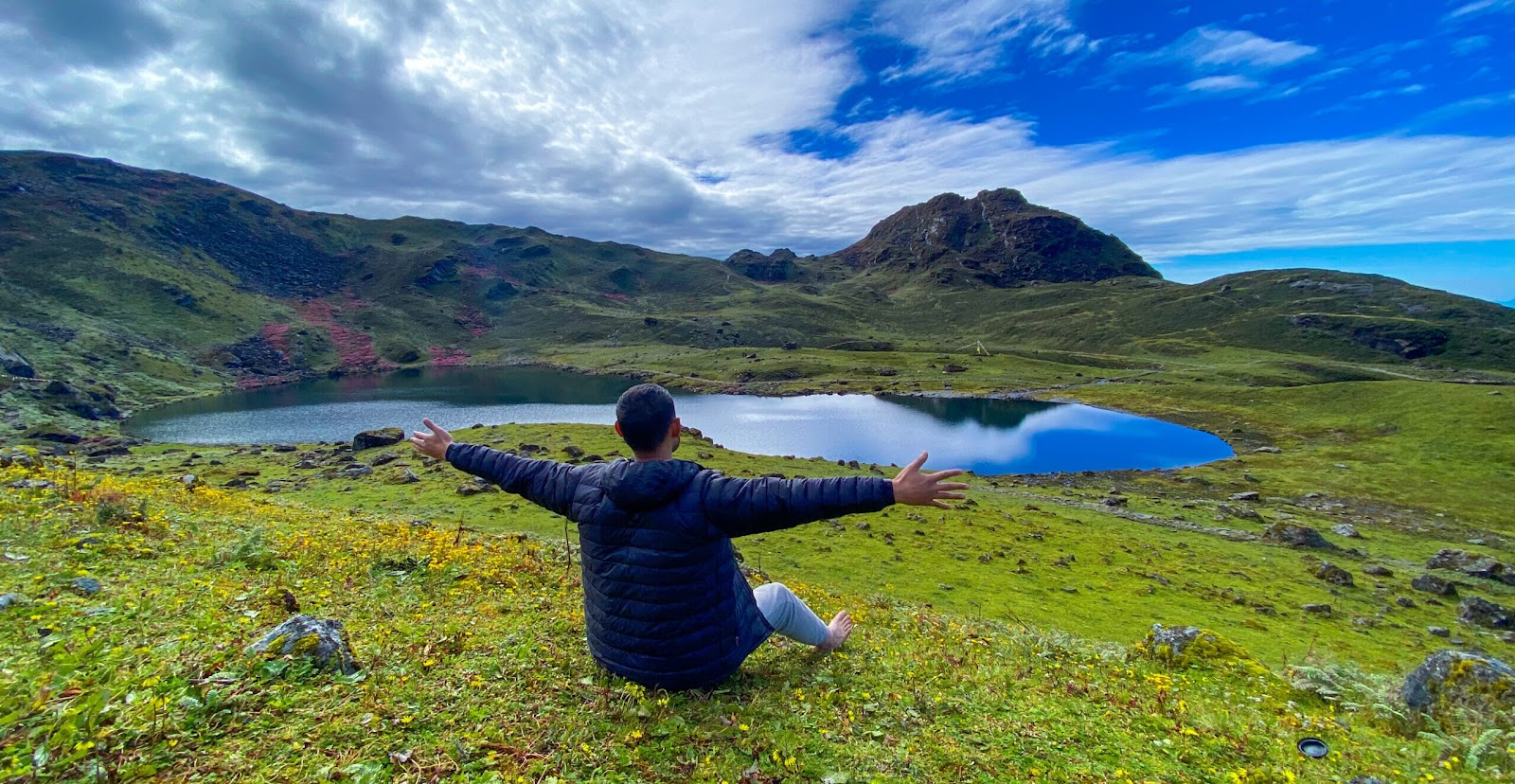
Cool mountain air, green alpine meadows, towering hills, snow-capped peaks, and the sight of five sacred lakes shimmering under the blue sky created a scene of extraordinary beauty. The reflections of clouds floating across the crystal-clear waters looked like paintings.
After breakfast, we decided to visit the famous Shiva Temple and the viewpoint above Panch Pokhari. Following a 40-minute uphill climb, we reached the viewpoint.
Before heading there, we offered prayers at the temple and washed our hands and faces in the sacred pond nearby. From the viewpoint, we witnessed spectacular panoramic views of the Himalayas.
The region is renowned for its high-altitude biodiversity, pristine natural beauty, and the magnificent Jugal Himalayan Range. Visitors can also enjoy views of the beautiful Langsang Valley, often compared to Italy's famous Dolomites for its dramatic alpine landscape.
From the hilltop, the five sacred lakes appeared scattered across the highland plateau, surrounded by rolling ridges and mountain peaks stretching endlessly into the horizon.
At that moment, all the pain and exhaustion vanished.
I felt as if I had arrived in heaven.
Anjan Dai took out his camera and began capturing the stunning scenery. Prerana wandered alone, filming videos of the landscape. As for me, I simply stood there, shouted with joy, and immersed myself completely in nature.
Soon it was time to return.
We trekked back to Chhimti, where we spent the night, and on the fourth day, we returned to Kathmandu.
Lessons Learned from My First Trek
This was not only my first long trek but my very first trekking experience. As a resident of Sindhupalchok district, I was amazed to discover such a famous destination in my own homeland.
As a television journalist covering tourism, the journey also inspired me professionally. Upon returning, I promoted Panch Pokhari through news reports and media coverage, believing that such destinations deserve greater recognition.
The trek taught me many valuable lessons. Proper preparation is essential before undertaking any journey. Understanding the terrain, weather conditions, altitude, and necessary equipment can make a significant difference.
It also taught me the importance of carrying medical supplies, pacing oneself properly, and allowing enough time for acclimatization rather than rushing toward the destination.
Despite the hardships, one thing became clear: reaching a destination after days of walking creates an indescribable sense of achievement.
Since returning, I have often found myself longing for another trek.
There is something magical about trekking. The experience of finally reaching a destination after days of effort feels almost spiritual. Even today, I struggle to find words that fully capture the emotions I felt at Panch Pokhari.
Perhaps time will help me describe them better.
The Spiritual Significance of Panch Pokhari
Panch Pokhari is not only famous for its natural beauty but also for its religious importance. The site houses a revered temple dedicated to Lord Shiva.
Many devotees believe that worshipping at Panch Pokhari brings peace, prosperity, and fulfillment of wishes. There is also a popular belief that women who pray here are blessed with a virtuous husband, while couples hoping for children may have their wishes fulfilled.
The site is sacred to both Hindus and Buddhists.
The five lakes are traditionally known as Bhairav Kund, Saraswati Kund, Surya Kund, Ganesh Kund, and Nag Kund. The area is also mentioned in the ancient Skanda Purana.
Large religious fairs are held during Janai Purnima and Haribodhini Ekadashi, attracting hundreds of pilgrims from across Nepal.
Panch Pokhari lies within the conservation area of Langtang National Park and has been included among Nepal Government's list of 100 major tourist destinations. Visitor numbers continue to increase every year.
Although Panch Pokhari possesses immense tourism potential, inadequate infrastructure and limited promotion have prevented it from reaching its full potential. Greater collaboration among government agencies, tourism stakeholders, local communities, and media organizations is essential to develop this remarkable destination sustainably.
I have reached Panch Pokhari once, and the memories remain unforgettable.
Now, perhaps it is your turn to experience its beauty for yourself.
Tags
📅 Published: July 22, 2026 | ⏱️ 1 min read