
Growth Trap: Why Nepal's Tourism Success Is Becoming Its Biggest Problem

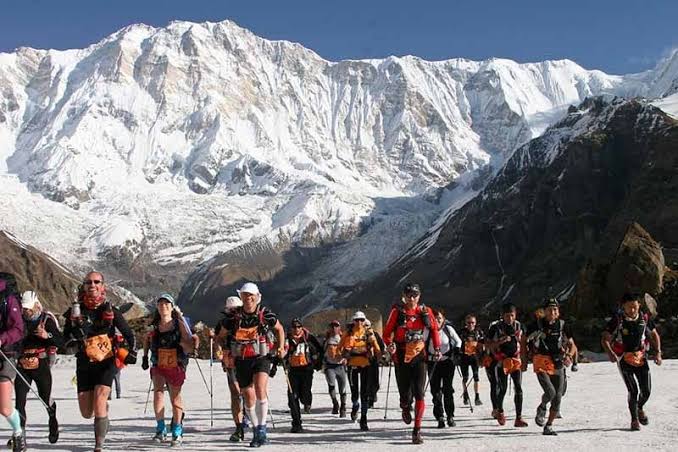
From the garbage-choked slopes of Everest to the eroding trails of Annapurna, Nepal is discovering that the country's greatest economic asset may be cannibalising itself.
There is a photograph that circulates every spring among trekking circles and environmental groups — a line of climbers snaking up the Hillary Step toward the summit of Everest, so densely packed it might be mistaken for a queue at an airport boarding gate. The image distils, in a single frame, the paradox that has come to define Nepal's relationship with tourism: the more people arrive to experience something rare and irreplaceable, the less rare and irreplaceable it becomes.
For a landlocked nation of roughly 30 million people, whose topography makes large-scale agriculture and manufacturing perpetually difficult, tourism has long seemed like destiny. Nepal contains eight of the world's fourteen highest peaks, a geography of staggering variety compressed into a country smaller than California, and a cultural heritage — Buddhist monasteries, Hindu pilgrimage sites, medieval Newari architecture — that rivals anything in Asia. The world beats a path to its door.
The question confronting Nepal now is whether that door can withstand the beating.
I. The Numbers Behind the Narrative
A Recovery That Masks a Warning
Nepal welcomed 1,147,548 international tourists in 2024 — a 13 percent increase over 2023, and nominally a sign of post-pandemic recovery. But that figure still falls short of the 2019 peak of 1,197,191, and hides a troubling trajectory. While global international tourism rebounded past 1.4 billion arrivals in 2024, Nepal continues to lag, held back by a transport infrastructure that regularly fails in lethal ways. Multiple fatal crashes and monsoon-triggered road closures shaved an estimated 5–7 percent off arrivals that year alone.
The arithmetic of per-visitor spending tells an equally uncomfortable story. Tourists in Nepal spend an average of USD 41 per day — a figure that has remained stagnant even as arrivals fluctuated. High-spending adventure travellers increasingly choose Thailand, Bhutan, or India, where the experience-to-hassle ratio is perceived as more favourable. Nepal is, in the blunt vocabulary of tourism economists, a high-volume, low-yield destination: it bears the environmental and social costs of mass tourism without fully capturing the economic upside.
The Leakage ProblemNepal's tourism income multiplier is estimated at just 1.21 — meaning each rupee of tourism revenue generates only modest additional economic activity domestically. The reason: high import content. Food, equipment, fuel, and luxury goods consumed by tourists are often sourced from outside Nepal, draining earnings before they can circulate through local economies. Foreign-owned tourism businesses compound the problem, extracting profits that never enter the local economy at all.
Tourism's contribution to GDP is variously cited between 3.6 and 7.8 percent depending on the year and the methodology — a range that itself signals how poorly understood the sector's real impact is. What is not in dispute is that the benefits are unevenly distributed. The gains concentrate in Kathmandu, Pokhara, and along established trekking corridors, while the communities that bear the heaviest environmental burden — remote mountain villages and national park buffer zones — capture the least.
II. The Mountain Under Siege
Everest as Symptom
No single location concentrates Nepal's tourism contradictions more sharply than Mount Everest. In 1979, Sagarmatha National Park — home to Everest — received roughly 3,600 visitors. By 2019, that number had grown to more than 58,000. The national park now absorbs approximately 80,000 people annually. The mountain has not grown to accommodate them.
The waste statistics are almost beyond comprehension. Approximately 200 tonnes of waste are generated on Everest every year. During peak climbing season, the Everest region produces an estimated 4.6 tonnes of waste per day. In the base camps alone, the spring 2022 expeditions generated over 44,700 kilograms of managed waste — food wrappers, oxygen tanks, batteries, tents, and clothing. Some of this waste dates back decades; as glaciers retreat under climate warming, abandoned equipment from the 1980s and 1990s emerges from melting ice.
"The two standard routes are not only dangerously crowded but disgustingly polluted, with garbage leaking out of the glaciers and pyramids of human excrement filled in the camps."
Mark Jenkins, National Geographic
Human waste is perhaps the most viscerally troubling dimension of the problem. Approximately 5,400 kilograms of human excrement are deposited in base camps annually. At high altitude, where temperatures rarely allow organic decomposition, this waste contaminates meltwater streams that flow down into river systems serving millions of people in the lowlands. Microplastics from synthetic climbing gear have been found in Everest's snow and streams at concentrations 100 times above normal background readings.
The Nepali government has initiated cleanup campaigns and introduced a $4,000 refundable garbage deposit, redeemable only upon returning with a minimum of 8 kilograms of waste — a policy that reportedly collected over 10,000 kilograms of trash in a single season. The Nepali army's Mountain Cleanup Campaign removed 110 tonnes of waste between 2019 and 2023. And yet, by every measurable metric, the accumulation continues to outpace the removal.
In 2024, Nepal issued 478 Everest climbing permits — a near-record number. At $11,000 per permit, the revenue is significant. But permits fund government coffers, not the Sherpa communities who physically clean the mountain, nor the downstream villages whose water sources bear the contamination.
Everest's Environmental Ledger
- ~200 tonnes of waste generated annually on Everest
- 5,400 kg of human excrement deposited at base camps each year
- PFAS microplastic levels 100× above background in Everest snow
- 110 tonnes removed by army cleanup campaigns, 2019–2023
- 478 climbing permits issued in 2024, each at $11,000
- $4,000 garbage deposit now required per climber
- 2023 saw the highest Everest death toll on record: 12 confirmed
- Bodies often unrecoverable due to extreme altitude logistics
III. The Trail Beyond Base Camp
What Everest Signals, the Annapurna Circuit Confirms
The pathologies visible on Everest are not unique to its slopes — they are replicated, at lower altitude and with less media attention, across Nepal's entire trekking network.
Trail degradation is one of the oldest and most persistent consequences of unmanaged trekking. Surveys of the Sagarmatha and Annapurna regions have documented excessive trail widening, deep soil incisions, exposed bedrock, and running water channels forming along trekking paths — problems that worsen with altitude, gradient, and traffic density. Overuse of specific paths, combined with the destruction of natural vegetation along their margins, removes the root systems that bind slopes together. The result is accelerated soil erosion that increases landslide risk — an already catastrophic hazard in Nepal's seismically active, monsoon-drenched terrain.
Deforestation is the environmental damage that perhaps most directly threatens the trekking product itself. Tourist lodges along the Annapurna Circuit and the Khumbu Valley still rely heavily on firewood for cooking and heating — a demand that has denudated hillsides visible from the trails that attract the tourists generating the demand in the first place. The Annapurna Conservation Area (ACA), the most visited trekking destination in Nepal with over 180,000 international visitors in 2018 alone, was established specifically to manage this tension. Whether it is winning the battle is, at best, uncertain.
Water contamination completes the triptych. Untreated sewage from lodges, human waste disposal by trekkers, and washing activities near river banks have degraded water quality along many popular trails. In the Khumbu, diseases like cholera and hepatitis A have been documented in communities that depend on streams now contaminated by tourist-generated waste. The communities that provide the picturesque settings for trekking photographs are drinking the downstream consequences.
The mountain that provides livelihood has also become a responsibility communities cannot escape. Sherpas often risk their lives carrying heavy loads of trash down dangerous slopes — cleaning up a mess they did not create.
One Globe Nepal
IV. The Economics of Maldistribution
Who Actually Benefits?
The economic argument for tourism in Nepal is superficially compelling. The sector generates over 500,000 direct and indirect jobs. In 2022/23, foreign tourists spent an average of $41 per day over an average stay of 13.1 days, producing a total economic impact estimated between $2.2 and $2.7 billion. Tourism accounts for 45 percent of Nepal's merchandise export earnings. For a country with few other hard-currency earners, these numbers matter.
But the headline figures obscure a pattern of radical maldistribution. Revenue leakage — money that enters Nepal's tourism system but flows straight back out — is endemic. The majority of payments for trekking packages are made to agencies based in Kathmandu or Pokhara, not in the villages trekkers actually sleep in. Food, fuel, and supplies are predominantly sourced from outside the trekking regions. Foreign-owned hotels and international airlines capture significant portions of the tourism dollar before it ever reaches a Nepali hand.
Tourism also creates local inflation wherever it concentrates. In communities along the Annapurna Circuit and in Lakeside Pokhara, the cost of goods and property has risen sharply — pricing out local residents and agricultural workers who have lived there for generations. Labour shortages for agriculture have emerged in communities where young men have been drawn into the trekking economy. The economic monoculture that tourism creates is fragile: COVID-19, political unrest, or a single season of bad weather can collapse an entire village's income overnight.
The Pokhara Hotel ProblemIn 2018, over 200 hotels in Lakeside Pokhara were formally deemed illegally constructed and slated for demolition. By 2024 — six years later — not a single structure had been physically altered. This gap between regulatory intent and enforcement reality is not an anomaly. It is the rule. Nepal's tourist-economy governance fails not from lack of law, but from lack of implementation.
The cultural dimension compounds the economic one. In remote villages along trekking routes, communities have had to adapt rapidly to the presence of large numbers of outsiders — adapting local customs, adjusting traditional practices, and transforming domestic spaces into commercial ones. What tourism boards advertise as "authentic cultural experiences" is, from the perspective of Gurung or Tamang communities, an ongoing negotiation between economic survival and cultural integrity — a negotiation they are conducting without much institutional support.
V. The Governance Gap
A Sector Growing Faster Than the State's Ability to Manage It
Nepal's tourism governance challenges are not primarily technical. The country possesses environmental protection legislation, national park management frameworks, and permitting systems sophisticated enough to be the envy of many developing nations. The problem is implementation — the chasm between what policy prescribes and what ground reality delivers.
The Sagarmatha Pollution Control Committee, which manages waste in the Khumbu, is under-resourced relative to the scale of the problem it faces. The Annapurna Conservation Area Project has pioneered models of community-based conservation that researchers cite as exemplary — but these models are expensive to sustain and dependent on donor funding that fluctuates. Permit limits on climbing expeditions remain politically sensitive, because permit fees are a significant revenue source for a government chronically short of foreign exchange.
The broader tourism regulatory environment reflects Nepal's governance challenges at large. Environmental impact assessments for new lodge construction along trekking routes are routinely bypassed. Trail maintenance is underfunded. Solid waste collection infrastructure outside Kathmandu and Pokhara is minimal. In September 2025, political unrest led to the destruction of tourism infrastructure including hotels and cable car stations, and triggered travel advisories from the United States, United Kingdom, Canada, Australia, and India — a reminder that tourism's vulnerability extends far beyond environmental degradation.
Tribhuvan International Airport, Nepal's sole international gateway, became a focal point for the sector's infrastructure failures in 2025 when a decision to close it for ten hours daily — for runway maintenance — produced the first decline in tourist arrivals since the post-COVID recovery phase. The country's entire international tourism inflow passes through a single, ageing runway. That structural vulnerability is not a failure of imagination; it is a failure of decades of investment priority.
VI. The Path Not Yet Taken
Is Sustainable Tourism Possible — Or Just a Marketing Category?
The phrase "sustainable tourism" has, in many contexts, been so thoroughly co-opted by marketing departments that it has lost descriptive content. In Nepal, however, it points toward something specific and urgent: a set of policy and infrastructure choices that could, in theory, decouple tourism growth from environmental and social degradation.
Bhutan offers the most frequently cited regional counterexample. By imposing a high daily tourist levy — currently $200 per person per day for international visitors — Bhutan has deliberately constrained visitor numbers while dramatically increasing per-visitor revenue. The result is a tourism sector that funds conservation, limits carrying capacity, and generates foreign exchange without the mass-market pathologies visible in Nepal. The model's applicability to Nepal is debated — Nepal's population is far larger, its geography more varied, and its political economy less amenable to top-down environmental management — but the underlying logic is sound. Nepal currently charges among the lowest tourism fees in the region for the most spectacular landscapes on earth.
China's management of the northern Everest approaches is instructive in a different register. Stricter permit limits, mandatory guide requirements, and rigorous waste management enforcement have produced measurably less congestion and cleaner slopes on the Tibetan side. The comparison is uncomfortable for Nepalese authorities, because it implies that the permit volumes Nepal currently authorises are a choice — one optimised for short-term revenue rather than long-term sustainability.
Community-based tourism represents a third option: one that routes economic benefit more directly to the communities bearing environmental and social costs, reducing leakage and creating local incentives for conservation. Nepal has genuine community-based tourism successes — the Ghalegaun homestay network in the Lamjung district, and several Indigenous-managed trekking routes in the Karnali region — but these remain niche offerings rather than structural alternatives to the mass-market model.
What a Sustainable Transition Would Require
- Substantially higher climbing and trekking permit fees
- Hard carrying capacity limits on the Everest corridor and high-traffic trails
- Revenue ringfencing: a proportion of permit fees flowing directly to Sherpa and local communities
- Mandatory waste-out protocols for all trekking parties, not just expeditions
- Firewood bans and accelerated solar/biogas deployment in lodges
- Trail maintenance endowment funded from permit revenues
- Enforcement of existing construction regulations in tourist zones
- Second international airport to reduce single-gateway vulnerability
Epilogue
None of these prescriptions is technically difficult. All of them are politically difficult — because they involve distributing costs across an industry whose stakeholders have powerful incentives to maintain the status quo, and because the Nepali state has historically lacked the institutional capacity to enforce regulations against well-connected economic interests.
The irony that hangs over Nepal's tourism dilemma is that the problem is a product of success. The country has done something remarkable: it has made itself indispensable to the global adventure imagination. People travel from every continent to stand where the Himalayas touch the sky, to walk routes where every turn reveals something genuinely extraordinary, to encounter a cultural landscape of extraordinary depth and strangeness. Nepal has not invented its appeal — it has merely opened its doors to it.
What it has not yet done is design a system worthy of what it is selling.
The danger is not that tourists will stop coming to Nepal. The danger is that by the time they stop, the thing they came to see will already be gone.
The glaciers are retreating. The trails are eroding. The base camp accumulates its tonnes. The permits are issued, the fees collected, the flights arrive at the one runway. And somewhere above the clouds, the mountain waits — patient, as it has always been — for the question of what comes next to finally receive a serious answer.
This analysis draws on data from the Nepal Tourism Board, the Sagarmatha Pollution Control Committee, the Annapurna Conservation Area Project, UN development assessments, and peer-reviewed research on Himalayan tourism ecology. Statistics cited reflect conditions as of mid-2026.
Tourist arrival figures: Nepal Tourism Board. Waste tonnage estimates: SPCC Annual Report, UNESCO assessments, and independent research. Economic leakage and multiplier data: ResearchGate and peer-reviewed economic analysis of Nepal's tourism sector.
📅 Published: June 17, 2026 | ⏱️ 1 min read